The vehicle computer (PCM/ECM/ECU), detects multiple misfires on cylinder number 2. You should not check the second cylinder of the engine firing order. Instead, you should look at the cylinder that is numbered “2” in the engine cylinder arrangement. In a Ford V8, for example, the cylinders on the passenger’s side are numbered from 1 to 4, and on the driver side they are numbered from 5 to 8. On the passenger side of a Chevy V8 or Dodge, the cylinders have numbers 1-3-5-7 and 2-4-6-8. The four-cylinder inline engine is numbered from the timing belt.
Table of Contents

A ‘misfire‘ can occur in one of the engine’s cylinders if the mixture of air and fuel is not ignited correctly. Proper combustion of air-fuel mixtures provides power to crankshaft, and therefore, the engine. Many factors can cause a misfire in one or more of the cylinders, including a malfunctioning ignition system, fuel supply, or internal engine. Most vehicles have four or six cylinders. The spark plugs on the top of each cylinder ignite the air/fuel mix with an electric spark. Small explosions are created in the combustion chamber when the air/fuel mixture ignites. The explosions are precisely timed for maximum power and efficiency. The energy released by these explosions powers the crankshaft. The cylinders are synchronised to control the rotation of crankshaft. This is the process that ensures smooth vehicle operation.
The crankshaft revolutions per minutes may increase or decrease if a misfire occurs. The vehicle’s computer will issue a fault code if the increase or decrease is greater than 2%.
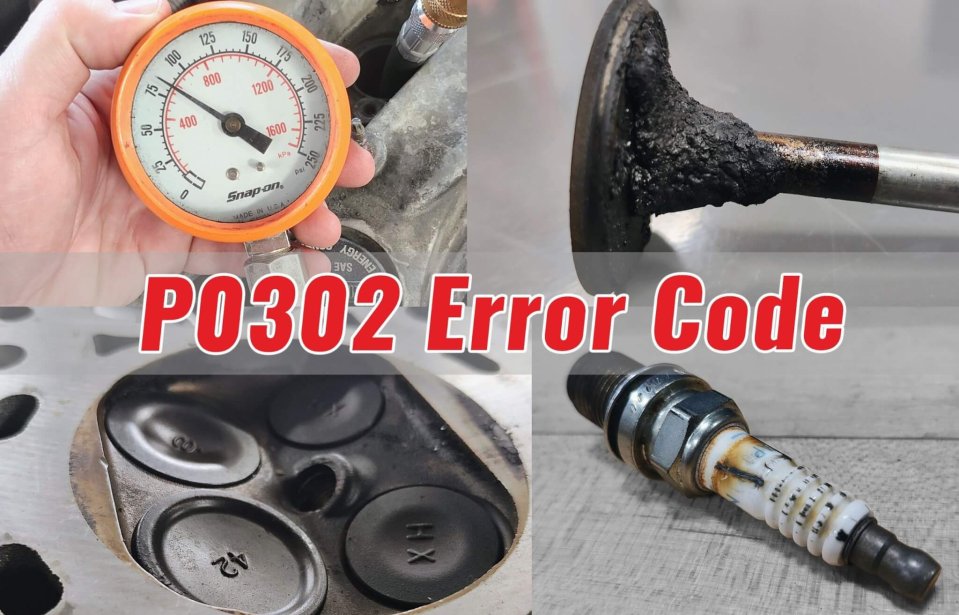
The engine fault light will come on if the number of crankshaft rotations per minute increases or decreases by 2% to 10%. The engine fault light will blink if this ratio is greater than 10%. Flashing engine fault lights indicate a serious misfire. Fault code P0302 indicates that the ignition is faulty (or there is no ignition at all) in the second engine cylinder.
All fault codes between P0301 and P0312 indicate that there is a problem with misfiring. The last two digits in the fault code will tell you which cylinder has a misfire. As an example, P0301 represents the first cylinder and P0311 the eleventh (for a 12 cylinder engine).
What are the symptoms of fault code P0302?
P0302 can have different symptoms. The driver may not see any other symptoms in some cases and only notice the Engine Control Light. Other symptoms include an engine that runs irregularly, is difficult to start, has misfires, stalls, or experiences slight gas leaks.
- The engine fault light will flash or continuously illuminate.
- The engine is not starting or has difficulty starting
- The vehicle is shaking and hesitating when it accelerates
- Instability
- Stuttering or stalling
- Fuel consumption increases
- Engine power loss
- Fuel odour coming from exhaust
What are the causes of the P0302 fault code?
This fault can be caused by a variety of factors. It could be caused by a faulty ignition coil or spark plug, both of which are relatively easy to fix. It could be due to a catalytic convertor or vehicle computer that is faulty. These are more expensive and difficult to fix.
- Spark plug 2nd cylinder faulty
- Compression insufficient in the second cylinder
- Faulty spark plug wires
- A defective ignition coil or plug
- Faulty distributor caps (some vehicles).
- Distributor rotor failure (some vehicles).
- Fuel injector wires damaged
- Fuel injectors that are not working properly
- EGR valve clogged
The ignition timing is incorrect - Vacuum leaks
- Low fuel pressure and level
- Leaking cylinder head gasket
- Faulty oxygen sensors
- Faulty camshaft position sensor
- Faulty crankshaft position sensor
- Faulty mass Air Flow (MAF), sensor
- Faulty throttle sensor
- Catalytic converter faulty
- PCM/ECM/ECU Faulty
- Engine mechanical issues. (e.g. leaking valves, worn piston rings, damaged pistons, worn camshaft, damaged lifter or cylinder head gasket).
How to Fix Fault Code P0302?
If there are no symptoms of a fault, the code should be reset and checked to see if it reappears. The code can be reset if there are no symptoms. Check to see if the code reappears. Check that the cables and connectors leading to the faulty engine cylinder are in good shape and secure. Depending on the age of your vehicle, and as part routine maintenance, you may want to replace ignition components. Check the ignition coils if the spark plugs and wiring appear to be in good shape. You can swap ignition coils to see if the problem is resolved. The ignition coil is to blame if the misfiring spreads to another cylinder. A faulty catalytic convertor is another possibility. This is evident by the rotten-egg smell coming from your exhaust. The problem could also be caused by fuel injectors that are faulty.
- Replace all spark plugs
- Replace spark plug wires and distributor cap, as well as the distributor rotor
- Replace the ignition coil faulty
- Repairing intake air leaks
- Repairing or replacing valve covers that leak
- Replace faulty fuel injectors
- Resolving fuel-related issues
- Replace the camshaft sensors if they are faulty
- Replace the crankshaft sensors if they are faulty
- Replace the mass airflow sensor if it is faulty
- Replace the oxygen sensor when it is faulty
- Replace the throttle position sensor when it is faulty
- Replace the catalytic convertor if it is faulty
- Fixing mechanical engine problems
How Important is Fault Code P0302?
You must fix the problem immediately if you want to avoid serious driving issues. This code may cause the vehicle to be dangerous. The vehicle could suddenly stop or stall. The engine can be seriously damaged if you delay repairs or continue to drive the vehicle. It must therefore be repaired as quickly as possible.