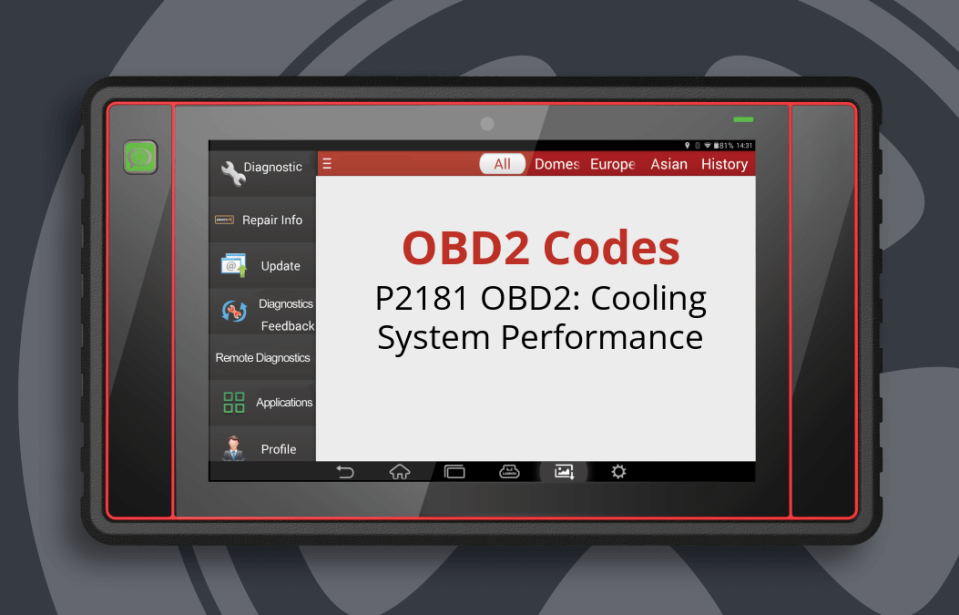
If the engine temperature is unusually high or low, fault code P2181 will be recorded. The Engine Coolant Temperature sensor (ECT) is responsible for sending the engine temperature information to the Powertrain Control Module. The PCM uses this information to calculate many things, including ignition timing and fuel distribution (more fuel will be required when the engine temperature is low). The engine temperature can also be used to activate actuators such as the EGR, cooling fan or EVAP purge. The PCM not only controls the fuel injection system but also calculates the average engine temperatures, the time needed to reach normal operating temperatures, as well as the lowest and highest temperature reached by the vehicle.
The PCM will set fault code P2181 if it detects the engine and radiator coolant temperatures are outside of the normal range. Normally, when this code is set the PCM enters emergency mode in order to prevent engine damage. Engine protection strategies may differ depending on the vehicle manufacturer. The symptoms of a vehicle’s engine may differ depending on its make, model and year.
P2181 is not a specific code, but a generic code that does not identify any particular component. This code is usually accompanied by other codes. The fault diagnosis and repair techniques are performed accordingly.
Table of Contents

What are the causes of fault code P2181?
- Sensor for engine coolant temperature (ECT), faulty
- A faulty thermostat (open or closed)
- Faulty pump (circulation water)
- Coolant leaks
- Radiator cap faulty
- Cylinder head gasket damage
- Overheating engine due to faulty cooling fan.
What are the symptoms of fault code P2181?
The symptoms that appear in a vehicle may differ depending on what type of fault is occurring. If a thermostat is left open or closed, different symptoms may appear.
- Engine overheating
- The temperature warning light will illuminate on the instrument panel
- Engine runs cold because the thermostat is left open
- Engine running lean or rich due to an incorrect air-fuel ratio
- Fuel consumption increases
- The heater of your vehicle is not performing as it should.
- Air conditioning system not performing as expected
- Problems starting the engine
- Fluctuations of idle speed
- Smoke and fuel odour from the exhaust
How to Fix Fault Code P2181?
You must consider all causes to accurately determine the problem. Repairs can be simplified by acting on other fault codes which appear along with this code.
- Replace the cooling fan if it is faulty
- Repair engine coolant leaks
- Replace the radiator cap if it is faulty
- Replace the thermostat if it is faulty
- Replace the water pump if it is faulty
- Replacement of the heater core or radiator faulty
- Replace the faulty ECT Sensor
The radiator cap should never be opened if the engine temperature is neither warm nor cold. The cooling system has been pressurised, and the average temperature of 195 degrees. Overheating can cause an engine to exceed 280 degrees. The third degree burns can be caused by opening the radiator cap when the engine is still hot.
How serious is fault code P2181?
It is usually possible to rectify the effects of an excessively cold engine. If excessive engine overheating is not dealt with promptly, it will lead to disaster. Even a few minutes’ worth of excessive engine overheating is enough to lead to a complete engine failure. Mild engine overheating can cause the cylinder head seal to swell/burn. Overheating the engine can cause the pistons in the engine to expand, causing them to become stuck inside the cylinder bores. This makes it impossible to repair. P2181 must be corrected as soon as possible.